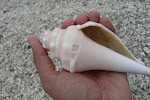
Recipe for ancient Chamorro adze replica
Ingredients:
1 Tridacna adze head
1 L-shaped wooden handle
A few yards of Coconut fiber cord
Instructions:
Uh....What instructions? Don't you just put all three together and then "Bam!" you got yourself an adze?
Well, I wish it is that easy. In embarking in this creative journey, I often am reminded that putting together the ingredients or parts that you need for a project is sometimes one of the hard parts. Instructions and guidance is another quite illusive integer in the equation. This post is about a project that is still very much unfinished at this point because it is taking me a while to figure out the recipe. But join me, and we'll "talk stories" about this and about that!
I wanted to make my own replica of the ancient Chamorro adze.
Gachai is the Chamorro word for adze according to the Chamorro-English Dictionary (Topping, Ogo, & Dungca) but I am not sure if it means the whole instrument or just the adze head. The
gachai was the tool that the ancient people of the Marianas (in fact in Micronesian islands) to cut, chop and carve wood. Although it is easy to imagine it as an axe as I described it, think of it more being shaped like a hoe, with the cutting shaft or adze head almost perpendicular to the wooden handle. There is an abundant amount of
Tridacna adze head artifacts left behind giving us a hint of how important this tool was for constructing houses, implements, and canoes. The
gachai is composed of an adze head that served as the blade, a wooden handle, and to bind the two, some cordage most commonly made of coconut fiber, or
gunot. So it was these three ingredients that I needed, and in the begining it seemed like such an easy undertaking.
The adze head
The ancient Chamorros utilized mainly the shell of mollusks for their adze head. The cutting shaft needed to be able to keep a sharp cutting edge and be hard enough to withstand a lot of hammering pressure. Shells of the spider conch or do’gas (Lambis sp.), large cone shells (Conus sp.) and the giant clam or hima (Tridacna sp.) were used for this purpose. I have seen pictures of haggan (sea turtle) bone used in other locales as well, but the hima was the most utilized in Micronesia.
There are a few species of hima in the waters of the Marianas, but the most abundant is Tridacna maxima (Röding, 1798), the elongate or maximum giant clam. It is not the largest of the giant clam family growing to only about 35 cm. in length. The bivalve shell is heavy, with pronounced radiating ribs that form concentric scales, and the edges are interlocking and scalloped. The shell exterior is off white or cream colored, sometimes tinged with yellow or orange, and the interior is white. The hima is a shallow reef dweller which makes it prone to it being overfished in many areas for food. Luckily for me, fragments of hima washes up readily on Saipan’s beaches, although finding a fragment big and solid enough is a challenge. (Please take note that it is illegal to take any live marine invertebrate on Saipan. Any harvest of hima must be done with a permit from the Division of Fish & Wildlife, Puerto Rico).
Here is a picture of a complete hima shell that I found in Obyan Beach, Saipan. It looks like it had been dead in the water for some time due to the encrustation inside and outside of the clam. It is a small specimen of 13 cm length and probably not thick or solid enough for an adze head.

I consulted The Catalogue of Prehistoric Micronesian Artifacts Housed in Japan (Intoh, May 1998) for some drawing examples of ancient adze heads. They had numerous illustrated examples from Saipan, Tinian and Rota, as well as Palau, Pohnpei, Kosrae, and the Marshall Islands. The illustrations showed me that the
hima was cut with a cone shaped end and a flat end that was sharpened in to the cutting edge.


This is the
hima fragment that I found at Wing Beach, Saipan and it is a 15 cm long fragment that I decided to use for my
gachai. It is not much longer than first clam shown above but this one was more solid at about 1 cm thickness. As you can see, I’ve already cut it to a typical adze shape. It is still unfinished since I have not yet grounded and sharpened the cutting edge and the other end that lies on the handle shaft will need some shaping done to it so that it sits well. I feel that it is a good start though.

 The handle
The handle for a
gachai needs to be hard and be able to take some pounding. The ancients could have used a number of indigenous hardwoods that could be found in forest and coastlines. I happened upon a
niyoron (
Cordia subcordata) that was butchered near San Jose Mart and that’s how I got this handle. It’s such a shame that property owners don’t know the value of trees though.
Niyoron is not a very dense wood, but I chose to use it for my
gachai to teach people of its importance. The Hawaiians esteemed this wood above all especially in the making of wooden bowls or calabashes. They called it
kou and venerated it more than the now popular
koa (
Acacia koa) at one time before it became a rare tree due to an insect infestation from the States that was accidentally introduced to the islands. Check out Jack Ewing’s website on woodturning in Hawaii and their native trees like the kou here (I am a big fan):
http://www.hawaiiwoodturning.com/. I wish our own islanders were more educated and appreciative of the native trees here. Check out the new Marianas Pride (MP) magazine's November-December 2007 issue for more information in an article on native trees and their importance.
Here’s a picture of the beautiful orange flowers of the
niyoron. Some people believe that orange was a venerated color to the ancient Chamorros because of the Spondylus
salape’ beads that they adorned themselves with. I really want to start a petition to change the CNMI’s State Tree and/or State Flower into indigenous/native ones. Why not place the same importance or esteem to the
niyoron? We need to start appreciating our local trees more and educate ourselves on their importance.

Here is the beginning of my
gachai handle. It will need to be carved to accommodate the
hima adze head, get sanded, sealed, and maybe stained. I may also put some Spondylus inlays and carve some ancient Chamorro symbols on the handle as well.

 The coconut fiber cord
Now this part of the ingredients is hard to come by on Saipan. I don’t think anyone here makes
gunot or coconut fiber cord anymore unless it is a very special occasion (for the construction of a traditional canoe or a canoe house for example). I have seen some for sale during cultural festivals from Yap, but a bundle costs about $80 to $100. Knowing what making this cord entails, I would have paid that much to get some to finish my project plus some others that I have rolling in my mind.
To make cord out of gunot, mature punot or coconut husks are buried under wet sand for several weeks so that the “flesh” rots away from the gunot (I think someone told me once that the rotten flesh of the punot was malodorous but I will have to verify. Can you imagine though?). The flesh is then pounded out to reveal the golden brown fibers that are then dried and made ready to be rolled into cordage. A good friend, Jean Paul C. who has spent many years in Pohnpei has witnessed this traditional work. He said that people sit around “talking stories” and they roll the gunot on their thighs with their palms. Now that’s a lot of work! If you’ve touched coconut fiber, it’s not like cotton at all. It is rough and itchy! But a good tightly rolled and twisted cord is what I need to complete the ingredients for my traditional hima adze replica. Luckily, JP (as we call him) took a trip recently to Chuuk, and was able to find a man who was willing to part with a few yards gratis! The man had it twisted on a small stick and I am so thankful for his generosity. That’s the island way!
So, every time JP leaves Saipan for one of the Micronesian islands, I always ask him to keep an eye out for cordage. Thanks, JP! One day, I will experiment to make my own, or hopefully, I will get invited to a rare cord making session. But please, anyone else knows how to get some, please let me know.

Now, I got the ingredients: 1 Tridacna adze head (needs reshaping and sharpening), 1 wooden handle (needs carving, sanding, sealing, and maybe staining, inlaying and decorating), and a few yards of coconut fiber cord (to bind everything together. I even cut a cone shell adze head for a second one:

I’ll post up a follow up on this a bit later. I am already experimenting with some traditional and ornamental binding techniques. After looking for coconut fiber cordage, I say that this is the hardest part of the recipe because there really are no instructions or someone who can teach me how to do this. But once bound, my ancient Chamorro adze replica will be done! So keep it tuned and we’ll “talk stories” some more.

 Thank you for letting me share.
The Beachcomber
UPDATE: Check out the finished adze and another one I made after.

 You have to go cut through some sword grass in the sabana to get to the islet.
 Happy hikers: Rosita and Laurina
 Then you go through a bit of secondary forest. It was pretty muddy and slippery. I thought for a second that maybe I shouldn't be so gung ho or determined the next time it's this rainy.
 Wild passionfuit or Passiflora suberosa
  Dizzying heights
 Can you see the fringing reefs?
 There she is!
 There was enough walking sticks picked up on the trail between Laurina and Rosita for an entire cadre of hikers.
 Looks quite treacherous!
 Easy! Carefull!
 Plenty rocks, nei!
 Pretty sandstones in the dirt
 Our constant seashore companion: Princess Naupaka, the Half-flower.
  You can see two types of Screw Pines here: Pandanus tectorius in the foreground with the slimmer, longer leaves, and P. dubious in the background with the wider, shorter leaves. The Chamorros call these Kafu and Pahong respectively. There will be a quiz later.
 Lantana camara or Wild sage. It is a pretty flowering shrub with an interesting odor.
 We found some Dodder or what the Hawaiians call Kauna'oa growing in the sabana or grassland
 Can you see the small white flowers of this parasitic plant?
 I blogged earlier about the Hawaiian island of Lanai's official lei made of orange Kauna'oa
 I made DJ a quick mwarmwar with Kauna'oa and Lantana .
  We made it! Laurina, JP, DJ, Lino and Rosita.
 JP on location
 Nice outcropping where you can see different layers of earth
 I see you!


 C'mon, Rosita! I'll catch you if you fall!
 JP, the avid photographer

 An hour or two later, it was time to climb back out
 Here's a curious sole with oysters growing in the little spaces or pockets.
 Plenty trash, nei!

 Goose barnacles (Lepas sp.) that were still alive attached to an old water jug.

 You see, you can only have admiration for this man, and I count myself very lucky to be his friend. He is a respected epidemiologist to people in the health profession all over the world. He has seen the rise and fall of epidemics, and has personally affected people’s lives with the preventive medicine that is his life endeavor. He is definitely someone I try to emulate not just professionally but due to the numerous talks that we’ve had, I also somewhat wish that I followed similarly in the footsteps of his personal life. Sure, he is not an infallible person, nor are his relationships perfect. But what JP is to me though (and to many others) answers the age old question of, “What do you want to be when you grow up?” My answer being, “I want to be a good man.”
 So, we got to talking about coffee and how we both appreciated a good strong brew, drinking it black in order to actually taste the quality of the beans. Just as in so many of our talks, I always somehow interject questions about women and relationships to hear what JP has to say backed with all of his wisdom, history and first-hand knowledge. No, actually this time was different as I said, “I just met an amazing woman, and guess what? She drinks her coffee black too!” A woman who appreciates the taste of pure coffee, he says to me, “Man, you better hold on to that one!” I smiled. My heart smiled too at the many possibilities at that time, yet some doubts and questions entered my mind. I finally had to ask, “JP, I really like her. How do I hold on to this one? ” He smiled wide and shrugged, “I don’t know. I’ve already found my coffee drinker. And when I did, I held on to her.” I chuckled and thoughts of JP and his wonderful wife, Frances drinking coffee together each morning into their midlives entered my mind. Smiling, I was left wanting for that same connection with someone one day.