I noticed some cord laying around that I rolled together while I was on Managaha Island two weeks ago. I was invited by the SDA School to do outdoor classes and I decided to do a nature walk with the younger kids to talk about plants and natural history. At the end of the walk, I picked up a dried screwpine (Pandanus tectorius) leaf, ripped off the spines and started thigh-twisting the strands to cordage. The Chamorros name for this particular screw pine is pahong. I was surprised how tough the cord was after I rolled it. Here's a post with a tutorial on how to make cordage.
 I also had a giant clam (Tridacna maxima) bead I took off from a necklace about a year ago that was just lying around unused. I decided to take it off of the nylon cord I had originally used and make a more natural piece. The Chamorro word for giant clam is hima and they called the shell money/ornamental beads, salape'.
 Hima is very difficult to cut and carve since its calcite-aragonite matrix is very hard, finely-packed and so crystal-like that it cracks easily when it gets heated. Here is the finished piece.
 I had a few extra strands of the leaf to roll a smaller cord for the salape' attachment. It is pretty tiring to roll the tiny cord with your fingers.I still need a lot of help with my technique. Can you see where I cheated? It's my secret.
Sadly, I did not have enough of the pahong leaf to use on the loop, and had to resort to using black nylon cordage. Here is a simple loop and knot for the necklace clasp.
 Voila'. It's done.
 Well, I am glad of the finished product since it is mostly all natural materials. I need more practice to really get the binding of these things done well. Come to think of it, I haven't had a lot of time lately to make any more necklaces.
 I did accomplish to get sleepy after everything was done so the project suited me well for the time it took.
Ti napu.
The Beachcomber.
PS. Oops! I misnamed the leaf that I used. There are two types of native screwpines in the Marianas: Pandanus tectorius which the natives call kafu' and Pandanus dubious which is locally called pahong. I have a picture of both in this entry. Check them out in the Guam Forestry website.


 This is Higam hima: Hugua (or two in the ancient Chamorro language). I salvaged the handle from a niyoron tree that was indiscriminately cut down to make room for one of Saipan's many strip malls. Guess what they have there now? You guessed right if you said pawn shop and video poker arcade!
 The handle of Hugua is not as straight as Hacha giving it a much different look and balance. Hugua is a reminder to me that we must remain vigilant in preserving the natural environment against careless sprawl. Here are some head shots.


 I like the stories though that come along in obtaining a unique piece. A lot of people belive that these special pendants contain Mana or spiritual power and the essence of the maker and then the wearer. I am really a big fan of the Polynesian matau designs and will probably make some in the near future. How did the ancient Micronesians design their fish hooks? I asked this question as I explored the idea of making my first hooks based more on ancient Chamorro or Micronesian designs.
 These are Isognomon perna (Linnaeus, 1767), also known as false pearl oyster or rayed tree oyster, that I found in Obyan Beach, Saipan. They are nacreous inside and their exteriors are an off-white color usually with broken brown radial stripes.
 Here is a picture from the CNMI Museum of History and Culture, Saipan that depicts the process of making a haguet from an Isognomon shell. I really wish I had a better close up picture because you can see that the finished haguet looks very different from the actual sea shell.

 This is a picture of a P. margaritifera valve that I found. It is bigger than the palm of my hands. It has a beautifully nacreous interior. Its natural beauty prevents me from cutting it into different pendants!


 Here’s a picture of nigas at Coral Ocean Point, Saipan. The common name is small-leafed mangrove, but it is not a true mangrove. Nigas is a coastal tree that you usually see living on jagged coastal rocks. I read that they can grow into medium sized trees at places, but I’ve only seen them in bush form on Saipan. I also read that they are over harvested in many areas because they make good bonsai trees. Driftwood from this tree is usually a rustic gray but when you cut, shape, sand and polish it, it comes out as a rich dark brown colored wood.
 Compound hooks are hard to make, but I will spend some more time learning a better way to produce them. Bone hooks need a little more investigating since the material is not as dense and is easy to scratch. I will need to do more research on how to properly make them, and even maybe order a book about bone carving.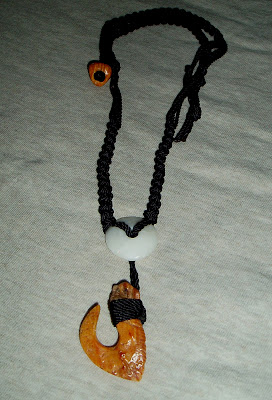


 Lastly, this is another stylized Spondylus haguet. The piece that I cut this from didn’t look too promising when I found it, but I am glad that I took the time to grind off layers from it until I carefully got the sheen that I wanted. This is a favorite piece. I paired this haguet with a Conus miles, or soldier cone salape’ bead.

 Thank you for letting me share once again.