So far I’ve been sharing a bit of what I know of the importance of the spiny oyster family Spondylidea to the ancient people of Micronesia especially to the Chamorros of the Mariana Islands of Guahan (Guam), Saipan, Tinian and Luta (Rota). The Spondylus bivalve (marine seashells with two valves) is sessile, cementing their shells to corals or rocks, which the ancient people collected live or dead washed up on the beach. Usually it is the top valve that were cut and polished into
salape’ (coin-shaped ornaments) that were bound together by natural cord fibers. At times the whole valve was kept intact, polished, and a hole or two were drilled in them to accommodate binding.
I’ve experimented and developed somewhat of a hobby replicating these artifacts and experimenting with other pendant shapes. I’d like to expand more in this blog what information I’ve collected on the biology and taxonomy of the Spondylus, but it is very difficult to distinguish between the species because of the numerous variations in shapes, forms, colors and sizes. I’ll put this part of my blogging on hold for a while until I get more information and better identifiable samples. Instead I would like to talk about a closely related family, the
Chamidae.
The bivalves of the family
Chamidae looks much like a spiny oyster because of their projecting spines and radial ridges. Because of their great beauty, they are commonly called Jewel Boxes. They are heavy thick shells that are a bit rounded, with the top valve flatter than the deeply concave bottom valve. I found that you could distinguish a
Chamidae from a Spondylus by looking at the hinge and the muscle scar inside of the shells. The Spondylus has two strong interlocking teeth-like hinges (A) and one adductor muscle scar (A1), while the Chama has a single tooth (B) that fits in a groove of the opposite valve and two muscle scars (B1). An internal black ligament connects the valves of the Spondylus, while the Chama’s ligament is external.

According to the Micronesica Vol. 35-36, June 2003 issue (G. Paulay, ed.), Guam has about nine species recorded including
Chama aperella,
C. brassica,
C. fibula,
C. iostoma,
C. lazarus, C
. macerophylla,
C. pacifica,
C. spinosa and one unidentified. The absence of reference materials with good photo representations are hard to come by so this adds to the difficulty in positively identifying some of the samples that I have collected. The Marine Biodiversity of Guam and the Mariana Islands website has a few pictures that you can check out to help identify local invertebrates:
http://128.227.186.212/reefs/guamimg/bivalvia/index.htmlChama limbula
On top of the difficulty in identifying what type of
Chamidae you may have, finding shell samples while beachcombing is equally challenging. The following sample is a rare beachcombing find since the two valves were intact together. It is a
Chama limbula (Lamark, 1819). It doesn’t look like a shell to be fascinated about from the outside since it is encrusted with white coralline algae and whatever spines it may have had have been eroded. Iinside it has almost a gemlike polished quality with purple coloration in the margins and a light jade-like green. The bottom valve is deep and the top is somewhat flattened. It is about 90mm at the longest measurement. I found it at Obyan Beach, Saipan in August 2005. I’ve made pendants out of these shells as you’ll read a bit latter on this post.
 Chama asperella
The next few pictures below are the different views of the upper valve of what I think is
Chama asperella (Lamark, 1819). It is a small Jewel Box that is mostly white with a pink umbone, or the pointed structure where the beak or the initial point of shell growth is. It is about 29mm at the longest measurement and is fairly strong and thick. Here's a picture of one
in situ:
http://128.227.186.212/reefs/guamimg/bivalvia/index.html 
The next two set of pictures maybe
C. asperella since they are mostly white, but they have purple radial coloration. This makes me think that they maybe a different species. There are not enough resources at the time for me to make a definitive call. They measure 2mm and 19mm in length respectively.

 Unidentified purple Chama
The next set of pictures is the external and internal views of a common Jewel Box that you can find washed up on many of the Saipan beaches. They are usually eroded or covered with encrusting algae. I don’t have a positive identification for these purple Chamas yet but they are fascinating nonetheless. Can anyone help me with the identification? Are they just another variety of
C. asperella? They are usually small with the largest pictured here at only 20mm at the longest measurement.

 Unidentified pink Chama
The next set of pictures is of again an unidentified Chama of which I pick up fragments infrequently at Wing Beach, Saipan. It has a pink hue and a pronounced undulating growth pattern. Anyone know what I is? It is comparatively of larger size in size to
C. asperella at 58mm lengthwise.
 Unidentified orange Chama (C. pacifica?)
This small 28mm sample of an orange tinged upper valve of an unidentified Chama is fascinating to me since a few spines are still intact. I’ve also included a few picture views of some similarly colored fragments. Anyone know what they are? I'm kind of leaning towards
Chama pacifica (Broderip, 1834) but am not totally convinced yet until I see a better sample.

 Unidentified spondylus-like Chama
I mistook the shells pictured next in external and internal views for young Spondylus. A closer look though revealed two adductor muscle scars and the strange striped pattern that occurs in
Chama limbula (visible when the surface is ground). I wonder if these are just young
C. limbula of are they a different species. The valves are quite thin and light, and the longest one is only 29mm.
 Chama lazarus and Chama brassica
Finally, pictured below is what looks like the Lazarus Jewl Box (
Chama lazarus, Linnaeus 1758). It is generally easy to identify since they are almost often white, with large scaly flattened spines. I don’t have any intact samples with both valves but here are pictures of separate top and bottom valves with the inner and outer views of the shells. They are popular with collectors when intact and the ones that are highly prized have extended forked spines.
I thought all of the samples pictured below were C. lazarus but the more closely I looked, the top middle and right samples were not shaped round like the other samples and their spines are short and scaly. I think that these maybe Chama brassica (Reeve, 1846) instead.
A Jewel Box for your jewel box

I haven’t found any evidence in my research for information about the ancient Chamorros utilizing Chama for ornamentation. It is well documented though that the Solomon Island natives cut and polished
Chama pacifica (
Romu in their language) into ornamental beads. They actually bring out the shell’s red color by exposing them to fire. Their money beads are called
Tafuliae and you can read about them here and see some pictures:
http://toabaita-authority.blogspot.com/2006/03/note-on-shell-money-tafuliae-that-is.html It is amazing how
Tafuliae looks vey much like the Spondylus
salape' beads that the ancient Chamorros made!
While beachcombing, I happened upon a polished upper valve of what I knew to be a bivalve at the time. It had an amazing swirl of colors and patterns that was unknown to me and it was ovoid in shape, which made it easy for me to visualize as a pendant. After reading a bit more and comparing the few samples that I was able to pick up, I concluded that these were
Chama limbula valves.
It seems that the Chama’s growth pattern on the top valve is an outward and forward moving swirl. As the animal grows and build upon its shell different colors are produced that may include white, browns, pinks, purples, and greens. A strange striped pattern occurs as the animal builds layers on top and away from almost the opposite side of the hinge. You wouldn’t know that these colors and patterns were present because in nature, the shells are often covered with coralline growth from algae or sponges, or they may even be eroded. To expose the colors, I had to grind the surface and chose (or guessed really) how much of the colors or patterns to expose. I usually leave the natural shape of the shell.
Below is the biggest
Chama limbula valve that I happened upon thus far. It is about 50mm at the longest measurement, and is solid and heavy. It turned into a gorgeous piece.


The purple swirl patterns of the next piece surprised me when I ground into it. How can such a small object hold so much beauty? This one is about 31mm in length.

The next picture below was the first Chama that I found and made into a pendant. The ocean did the polishing for me, the shape is natural and uncut, and I actually just drilled a hole to accommodate the binding.

The next piece below has a very busy color pattern of brown, pink and white, and it even has a hint of blue. I paired it with a smaller type of Chamidae made into a
salape’ or coin-shaped bead. The smaller bead is one of the unidentified purple
Chamidea polished.

Thanks again for letting me share
The Beachcomber



 As I was working on the other lago' pendant, my friend Bev C. called me saying that she was having a hard day. She was missing her family and life in California and she would have left that instant if she could to rejoin them. Even though I understood where she was coming from, I got a bit sad thinking that I was losing another friend. I take it pretty hard when people leave, I mean it's already hard to find good friends on a small island and when you do, there isn't always that permanence. I am usually pretty bad at corresponding too, so I lose out on them even more after friends have left.


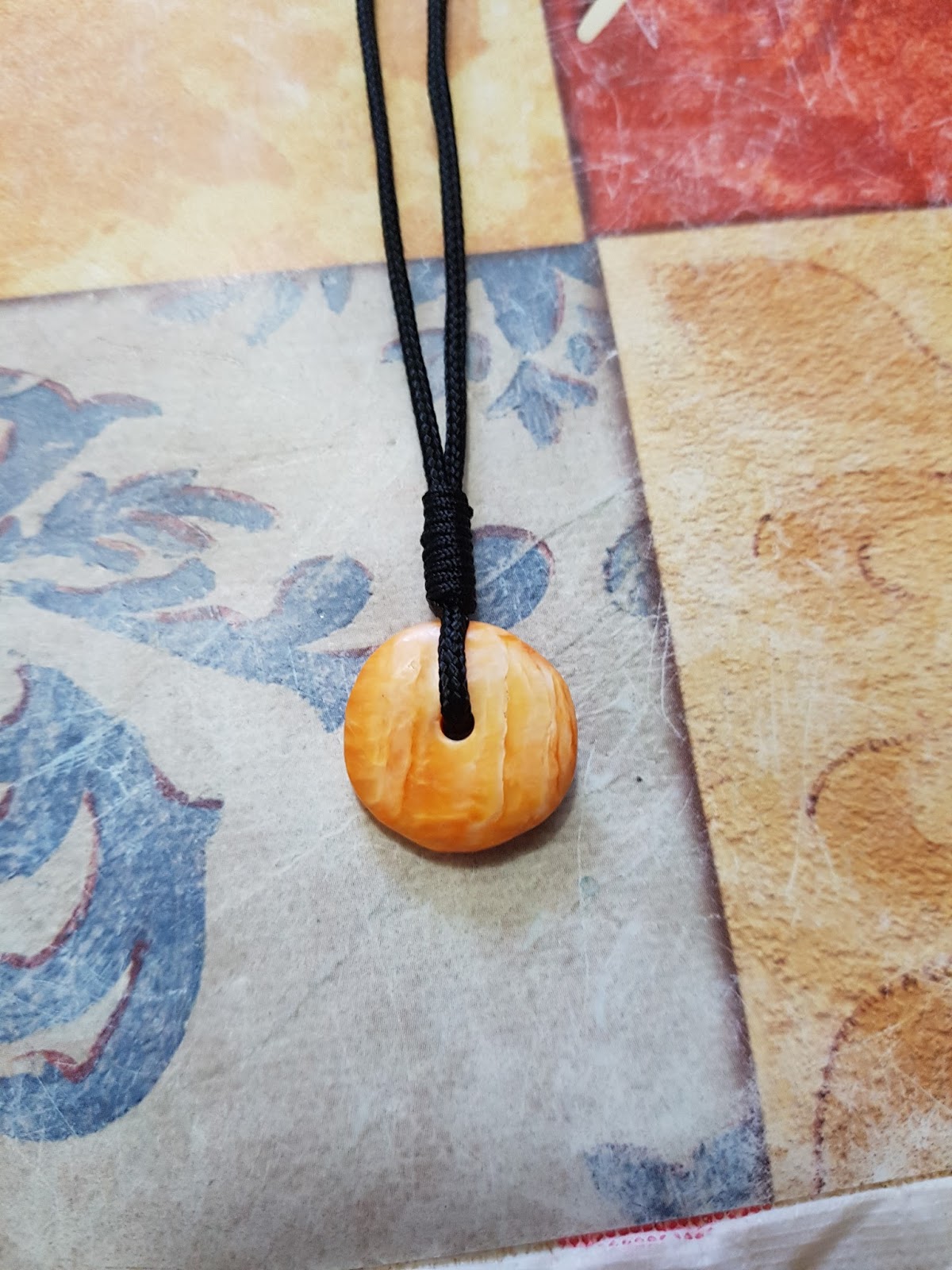
 This next bracelet I call Cinnamon. It is made up of two orange Spondylus salape’ beads and the center bead is of an uncommon cinnamon colored Spondylus. This beauty is one of a kind!


 Thank you again for allowing me to share.