Chances are slim unless you frequent the laboratory or the dialysis unit at the Commonwealth Health Center. I've often wondered about this painting because of the curious rock formation jutting as the focal point of the picture. Where is this place? Is it a real place or is it made up? If it is a real place on Saipan, how come I haven't seen it? If it is made up, why paint such a curious formation? No one I asked at the hospital could give me any answers about the curious painting.
I've had the bug to go hiking this past Sunday because I wasn't able to go hiking with my church family to Forbidden Island. Hayden Luke turned a year old and he had his party on the same day. So, Sunday morning I was ready for an adventure.
I asked Laurina and DJ if they wanted to go exploring in some place new. The mother and son team is always ready to go so, we grabbed some breakfast, packed some fruits, snacks and some drinks for a full day of hiking. Here's the pair making their way down a steep descent in the trail to Old Man by the Sea.
 The false rattan (Flagellaria indica) were in bloom.
 So were the Sea hibiscus or what the locals call Pago (Hibiscus tiliaceus)
 The mature flowers of Pago are orange-pink while the younger are bright yellow. The leaf litter had yellow petals strewn here and there that looked as if previous hikers went down the trail puling them off and discarding them.
 I need a tropical fungi guidebook, but I've seen these white ones before and they are usually attached to rotting wood.
 The Sumac or (Aidia cochinchinensis) were also displaying their pretty and fragrant blooms.
 When we finally made it down to the beach, the tide was really low. Buenas, Old Man!

 The sea seemed somewhat calm due to the negative tide, but always be careful at this part of the beach and beyond the reef flat. The currents are dangerous and the waves are unpredictable.
 We went through this hole...
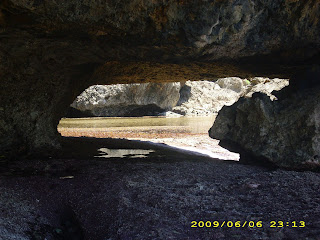
Headed for the boulders on the north side of the beach...
 Squeezed in between the rocks...

Finally reached the "wall"!

After testing the rope and assessing the difficulty level of the climb, it was gut check time for both Laurie and DJ. After praying for safety, the two struggled with whether or not this was a climb they would want to risk. I positioned myself as best as I could to assist midway the top. DJ tried first but after the first 6 feet, he got scared because it was really high and quite sheer. I thought that I would have to go on alone on this one, but after a minute or two, he psyched himself into trying again. He even assured his mom by saying, "Just clear your mind, mom. Embrace the darkness." Laurina and I had a good laugh.

Laurina is also very afraid of heights which worried me. The two did well though and were all smiles when they got to the top. I made them look down the wall and told them that they need to mentally prepare themselves for the climb down later. After a few minutes of following a trail, we finally reached our destination.
Welcome to Saipan's Second Grotto!
The Second Grotto is a collapsed limestone cavern. You can hear the sea surging in and out even though you couldn't see the water from above. There were some nice stalagmites, stalactites, drip and flowstones, and even a pair of White-tailed Tropic birds (Phaethon lepturus) nesting within. The Chamorro name is Fagpi-apa'ka or Fakpe. They were clearly warning us to stay away with their calls that soundeds like keee-keee-krrt-krrt-krrt. Their extra long central tail feather always amazes me!


 Can you see her at the bottom right of this picture? This place is huge! It reminded me of the huge sink hole close to the Hilton Hotel on Guam that my friend Brian and I used to visit.

 Time to climb out! After a drink and snack break, it was time to go. The two were too tired to look for the cave entrance that would lead us 20 feet into the cavern so we just spent time exploring the outside and looked at the awesome vista.
 The view from the outside. Aha! This is what made it click! The mystery!
 This is a view of a possible underwater access to the Second Grotto. There is evidence of cliff fishing here which is pretty sad because people leave their trash where they fish. Pick up after yourselves, messy people!

Can you see the Haggan (green sea turtle). It was taking in gulps of air directly under the cavern roof!

The seaside view.
 Caveman DJ at one of the interesting holes cliffside.

After the viewing, it was time to climb out.
 I can see the back of the head of the Old Man now!
 After this hike, it was hot and we had the urge to go swimming so we decided to go to Tanke Beach, Kagman. We will save that adventure for another story.

Monday morning came and I just had to look at the painting again at CHC. The mystery of the painting was solved!
 I hope you enjoyed talking stories once again. Ti napu.
The Beachcomber


 This next bracelet I call Cinnamon. It is made up of two orange Spondylus salape’ beads and the center bead is of an uncommon cinnamon colored Spondylus. This beauty is one of a kind!


 Thank you again for allowing me to share.