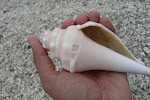
Sea beans are seeds or fruits that wash into the sea, drift for some time and then get washed ashore. They are also called drift seeds or beans. There are a handful of different kinds that you can find on Saipan that usually wash up on the eastern beaches. I am still trying to figure our if it is sustainable to include see beans for my project. The above picture is that of a kukui nut (Aleurites moluccana) which I originally thought drifted from Hawaii. I've been finding quite a bit of them lately.
SEA HEARTS (OR MONKEY LADDER BEANS) The sea heart (Entada gigas) is a well known sea bean because of its curious shape, big size, and high polish. The ones I've found are dark brown and have a very hard covering making them appear like wood carved hearts. Sea heart vines are lianas (woody, long-stemmed and rooted on the ground). Parts of the thick vines grow ribbon-like and this prompted the common name, monkey ladder vine. I haven't seen these vines growing on Saipan. It would be interesting to find since they own the record for bearing the largest seed pods (over 5 ft. or 1.5m).
 Another monkey ladder vine is the snuff box bean (E. rheedii) since the hard seed covering was used as snuff boxes. In Chamorro it is called, bayogon dankulo (kneecap, big) and the seeds are reddish brown, almost rectangular in shape and are supposedly poisonous. The leaves and stems are used in traditional medicine. Its synonym is E. pursaetha and another common name is the African dream herb since its leaves are dried and smoked there supposedly to induce vivid dreams.
LITTLE MARBLES
I do not have a lot of information about this beautiful marble-like seed. They are also called glass eye vine (Oxyrhynchus volubilis). I usually find them covered in a beige, corky layer that need to be scrapped off to reveal the shiny black to dark brown seeds.
SEA PURSES
The sea purses we mostly see here are Dioclea wilsonii. They somewhat resemble our local bayogo (Mucuna gigantea) but are generally bigger and the hilum (where the seed attached to the seed pod) has a bright yellow border. Does it look like a tiny purse? See the yellow border of the hilum?
 Most sea purses I've found are reddish brown but this one (my favorite amongst) is mottled in color. I still need to clean this one up since it had goose barnacles (Lepas sp.) attached to it (white specks).
BURNEY BEAN
Burney in Old English means "island brook". We know these seeds locally as bayogon dikike (pronounce the y sound as a z) which literally means "knee cap small". Most of the ones I've collected are from the vine. They range in color from light to dark brown or mottled with black like the ones below. These seeds are the basis of the bayogo (bojobo) doll industry, seed leis and are extensively collected in the Mariana Islands. Like bayogon dankulu it is used in traditional medicine. Scientifically it is called Mucuna gigantea and like most of its family members, their seed pods have stinging hairs (trichomes) so you have to be careful collecting them. More on this on another post!
BROWN HAMBURGER BEAN
Hamburger beans (Mucuna sloanei) are a joy to find washed up on the beach. They are smaller in diameter and rounder than sea purses. The surface of the seed is polished but rough and the hilum is thick and dark. Does this really look like a hamburger?
 CANDLENUT
I was first made familiar with the kukui or candlenut (Aleurites molucanna) out of Hawaii's seed leis so I thought these were mainly from Polynesia. I now know that they are native in Asia and they even grow as close to us as Pohnpei. Maybe that's why they are pretty common drift seeds here. They polish quite nicely and I may have enough to put together for an authentic seed lei. Problem is if the seed inside is rotten, it is oily and pretty stinky so I will have to find a way to remedy those two problems. I haven't had much luck locating trees on Guam nor here on Saipan. That's a nice shine! The seeds really take a good polish. Also, the oil inside the seed really does burn like a candle.

MARY'S or CRUCIFIX BEAN
Finding Mary's bean (Merremia discoidesperma) this past weekend was quite a surprise! This drift bean holds the record of having the longest drift of 15,000 miles (24,000 km). Sure other sea beans can stay buoyant longer potentially drifting father, but where they originally came from is hard to determine. Mary's bean has a limited range growing only in Mexico and Central America though.
 Mary's bean has been found as far up north as Norway. If the record distance was set by beans found in the Republic of the Marshall Islands (Bikini and Wotho Atolls) then we may have a record breaker in our hands! Old Man by the Sea, Saipan, CNMI is farther than the RMI!
 Because of the cross-like indentation on the "top" side of the bean, it has religious significance to some people. It is named after Mary, the mother of Christ and is also known as the Crucifixion or Crucifix bean. It is supposed to be good luck to carry one and women in labor carry them to ease the pain. Some of these are heirlooms being passed from one generation to the next.This is the record breaker's "bottom" showing the hilum, the scar where it once attached to its fruit.
 GRAY NICKARBEANS OR NICKARNUTS
I love the unique look of the Gray nickarbeans (Caelsalpinia bonduc). They look like small gray eggs with parallel fracture lines. Nicker is a Jamaican word that came from the Dutch knickker, a baked clay marble. The Chamorros however locally call them, pakao. They are used in traditional medicine. Incidentally, bonduc came from the Tagalog word for mountain, bundok. Boondocks is also a Western derivative that means backwoods or out of way place.
 I finally found some Gray nickarbean vines. They are pretty spiny which led to another common name, wait-a-bit vine. I am going to have to return to the spot see when they flower and bear fruits.
 SCREWPINE
These aren't seed but are part of the woody part of the screwpine (Pandanus tectorius) fruit. I've used screwpine leaves for cordage but these specimens are so pretty that it looks easy to craft them into things. These are lightly sanded and once coated with tung oil. My BFF, Laurina, thinks they look kind of spooky because the holes look like the eyes and mouth of the grim reaper. I don't see it but do you? This one is probably from a different Pandanus species that I've yet to identify. It's probably not from here since we really only have 2 species locally. It is pretty nonetheless!
 I have found other interesting drift seeds and sea beans to share later. I finally identified a pretty weird looking black seed that felt and looked like a plastic ball. It turned out to be palm nuts from a species of prickly palm trees (Acrocomia mexicana) that grown in South America and West Indies. I didn't have any picture so I will have to share later.Hope you liked my stories. Check this and this which are other sites that are chock full of information on sea beans and drift seeds.
Ti napu.
The Beachcomber
P.S. I misidentified the Little marbles and you can read about their true identity here.


 I actually sometimes prefer eating a mango this way just when it is starting to ripen so that the flesh is turning yellow, tastes between sweet and sour, and still firm. The locals call this stage, to'a literally meaning "ready for picking" or "mature".
  These are considered "Saipan" or Local as well, even though they did not have the reddish blush and maintained a green to yellowish skin color when ripe.
 Here is the bright yellow flesh with medium stringiness. I like the taste since it is a bit tart.
 The locals say that a Saipan Mango that has either rough skin (from being attacked by insects) or blackened skin is usually the sweetest pick of this kind.

 I am pretty sure that it is the same variety as the ones I had growing up called Kalabaw, the Tagalog word for carabao (water buffalo), but I am not sure what the difference is from the highly praised and heavily imported Philippine Super Mango. The Super Mango is yellow when ripe, not as ovoid, and almost has a "beak" in the terminal end. I do not think you'd come across any Filipino who would not laud this as the "best" and their favorite. I can't say the same though since I have not tasted close to all the different varieties from different localities. The Super Mango does seem to have a perfect blend of sweetness and tartness, and is almost fiber-free. The Carabao in the Philippines constitutes 66% of crop production.
 Haden Mango