Form left to right: Cecille works at Physical Therapy. Niko works at Medical Telemetry. Laurina works are Pediatrics. RC works at MedTele with Niko.
 We met RC via Niko last year and we went on a few outdoors excursions with them until he got hired at the hospital and got too busy with work. I am glad we had another chance to explore nature.
 Niko wanted to take RC and Cecille to some Japanese WWII caves in Navy Hill that were built more than 60 years ago as a refuge against the Allied forces. You have to follow a usually dried stream bed and navigate through the slippery limestone forest to get there. The Pierson's shared this hike with us a few years ago, and Dr. Ken was familiar with the place since the Xterra Races go through the caves and the trail as an obstacle.
 After a few minutes walking along the stream bed, you'll spot the first opening of the caves on the left. You can see how they were hewn out of the limestone cliff.
 There is a lot of room inside but it is pretty dark so you'll have to bring flashlights.
 This is our second trip here with Niko. Niko is one of my first friends here on Saipan along with Laurina since I met them together going through nursing school. We all got our nursing degrees from the Northern Mariana College in 2004 and still occasionally hike or hang out together.
 We sometimes call these the "crystal caves". They are full of deposited calcite and aragonite that seep through the limestone walls as they are dissolved by rainwater. Limestone is porous and even man-made caves such as these start to develop natural cave features or speleothems (like stalactites and stalagmites) given time. The picture below gives you is a pretty good clue as to how the water and dissolved minerals flow through the roof and down to the walls and floor of the cave.
 The crystal formations are beautiful, almost like frosted sugar. The picture bellow illustrates a gorgeous flow stone formation. They are also very delicate so we try our best each time we visit not to destroy or disturb the site. Imagine the Xterra racers going through here though.
 Here is RC pointing out soda straws. A soda straw is a speleothem that is a hollow mineral tube of calcium carbonate or sulfate. As each drop of mineral rich water hovers at the tip and a ring of minerals is left at the edge when the water drops. Each drop of water can deposit a little more mineral before dripping, slowly building a tube. Stalagmites or flowstone can also form where the water drops to the cave floor.
 A soda straw can turn into a stalactite if the hole at the bottom is blocked, or if the minerals are deposited outside surface of the tube.
 Can you see patterns of the water deposit?
 Here are some really delicate flow stone features on the cave wall. Amazing and beautiful!
 Amazing and beautiful, but this time in the form of my BFF!
 We had a little snacking moment outside of the caves after we reached the end. We still had some energy and decided to hike up the trail a little more.
 I started finding some seed that I blogged about for one of my projects. This is the source of the sea or drift beans! The round ones are from what the Chamorros call Nonnak (Hernandia sonora), the big round one is called bayogun dankulu (Entada rheedii), and the dark flat ones are bayogun dikike (Mucuna gigantea).
 I totally made a mistake on my first blog about sea beans on the identity of the Black Marbles. They are not from the glass eye vine (Oxyrhynchus volubilis). They are from the Nonnak after all! Here are the fleshy pink pericarps on the forest floor.
 A Nonnak sapling grows quite readily from the seed on the forest floor. I need to collect some for my native tree planting projects. They are gorgeous trees for landscaping and the bowed trunks were once used for canoe outriggers.
 I wanted to explore more since I spotted the woody vines or lianas of the bayogon dankulo.
 Laurina spotted this one that can probably support a man's weight! This is what Tarzan probably used to swing from tree to tree.
 I didn't see a "monkey ladder" formation though that develops when the vine grows in a spiral or twisty manner. I truly wanted to spot its huge seed pods though.
 I was only able to spot parts of the huge pods on the ground. I want a complete one for my personal collection but they are so hard to find!
 This is a picture of one from the Thursday Night Street Market that showcases a complete seed pod. This seed pod is a few feet long and you can see the bayogu seeds made into dolls in the display here.
 Only fragments were found. I have to search harder for a complete one it seems.
 It's interesting how the woody side structures are retained and the middle pods are separately discarded to split up and release the big seeds.
 Fungi!
 Funguys!
 We also found some wild chiles! These are locally known as donne sali (donne means chile and sali is the endemic Micronesian starling or Aplonis opaca) and is a variety of Capsicum annum or domesticated chiles. In the Philippines, we call these types siling labuyo (Labuyo is a jungle fowl) and is reported in both cultures as being very spicy. One day, I'm going to have to see where it really is in the Scoville scale.
 I hope the crows and the jungle fowls don't mind us gathering their donne. These will make a deliciously hot marinade after the hike! Who is cooking, guys? Anyone?
I had to let the party go ahead most of the time so that I could explore a little bit more of the place slowly. We were just following the trail back to get to the vehicles. There goes Laurina the Explorer!
 Maple leaf-shaped leaves? Big football-like fruits? What is that? I don't know what kind of tree that is? Wow! A mystery tree!
 There are whole lot of them here! They look amazing! I've got to figure out what they are!
 I thought these seeds were dokduk or the Seeded breadfuit (Artocarpus mariannensis) but they are not! The seeds were all over the forest floor and were readily sprouting. Oh, well. I'll figure it out one day!
 On the way out, we saw that the Japanse shrine at Sugar King Park was open- a rare event! We wanted to see if we could ring the bell, but there was a solemn prayer going on inside.
 Thanks for suggesting the hike, Niko! Let us go again soo!
  Ti napu.
Maple leaf-shaped leaves? Big football-like fruits? What is that? I don't know what kind of tree that is? Wow! A mystery tree! There are whole lot of them here! They look amazing! I've got to figure out what they are!
 I thought these seeds were dokduk or the Seeded breadfuit (Artocarpus mariannensis) but they are not! The seeds were all over the forest floor and were readily sprouting. Oh, well. I'll figure it out one day!
 On the way out, we saw that the Japanse shrine at Sugar King Park was open- a rare event! We wanted to see if we could ring the bell, but there was a solemn prayer going on inside.
 Thanks for suggesting the hike, Niko! Let us go again soo!
  Ti napu.
The Beachcomber


 The false rattan (Flagellaria indica) were in bloom.
 So were the Sea hibiscus or what the locals call Pago (Hibiscus tiliaceus)
 The mature flowers of Pago are orange-pink while the younger are bright yellow. The leaf litter had yellow petals strewn here and there that looked as if previous hikers went down the trail puling them off and discarding them.
 I need a tropical fungi guidebook, but I've seen these white ones before and they are usually attached to rotting wood.
 The
The  When we finally made it down to the beach, the tide was really low. Buenas, Old Man!
 The sea seemed somewhat calm due to the negative tide, but always be careful at this part of the beach and beyond the reef flat. The currents are dangerous and the waves are unpredictable.
 We went through this hole...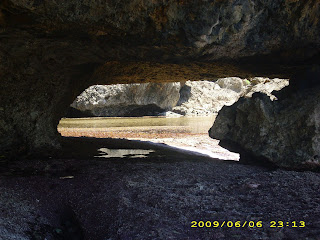
 Squeezed in between the rocks...


 Can you see her at the bottom right of this picture? This place is huge! It reminded me of the huge sink hole close to the Hilton Hotel on Guam that my friend Brian and I used to visit.
 Time to climb out! After a drink and snack break, it was time to go. The two were too tired to look for the cave entrance that would lead us 20 feet into the cavern so we just spent time exploring the outside and looked at the awesome vista.
 The view from the outside. Aha! This is what made it click! The mystery!
 This is a view of a possible underwater access to the Second Grotto. There is evidence of cliff fishing here which is pretty sad because people leave their trash where they fish. Pick up after yourselves, messy people!

 Caveman DJ at one of the interesting holes cliffside.
 I can see the back of the head of the Old Man now!
 After this hike, it was hot and we had the urge to go swimming so we decided to go to Tanke Beach, Kagman. We will save that adventure for another story.
 I hope you enjoyed talking stories once again. Ti napu.